

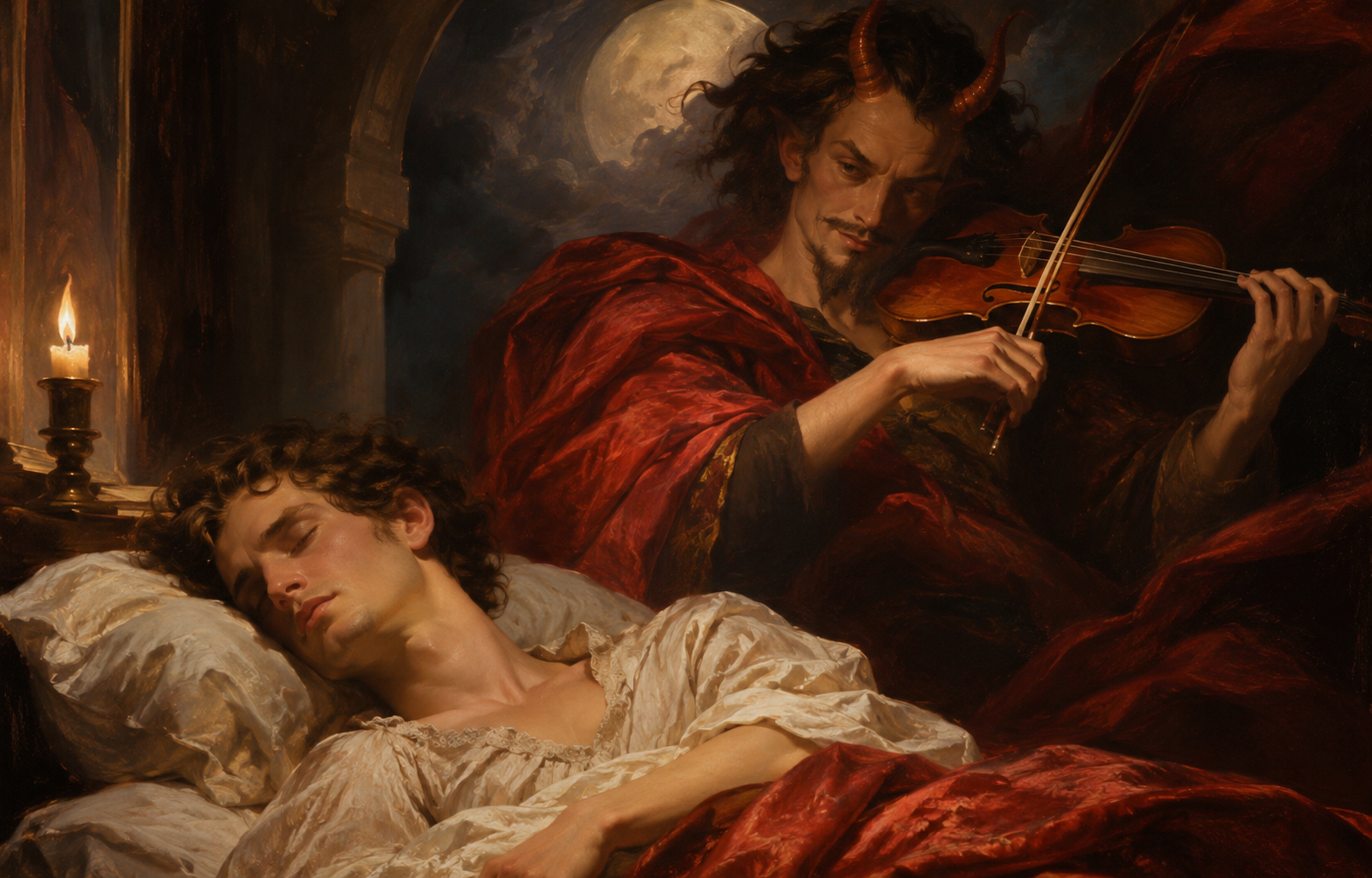

Giuseppe Tartini dreamed that the Devil was playing the most beautiful music he had ever heard on his violin. When he woke up, he tried desperately to reproduce it. Thus was born one of the most captivating works in the history of music.
A Pact with the Devil
Giuseppe Tartini was born in 1692 in Pirano, a small coastal town in Istria, which at the time belonged to the Republic of Venice. He was one of the most important violinists and composers of the 18th century, a man who devoted his life to the pursuit of musical perfection.
He was 21 years old when, one night, he dreamed that he had made a pact with the Devil. He had given his soul to the Devil, and in exchange, the Devil had become his servant, eager to fulfill his every wish.
At first, the young musician reveled in the limitless possibilities this strange pact offered him. Until he thought of something simple: to give his violin to the Devil and listen to him play.
The Devil took the instrument and began to play a sonata so dazzling, so beautiful and technically unimaginable that Tartini felt he was in the presence of something that transcended all human capability.
It wasn’t just the virtuosity. It was the music itself. A sequence of sounds that seemed to reveal the existence of a beauty hitherto unknown to the world. The emotion was so intense that the composer woke up with a start.
The Music Lost Upon Waking Up
Tartini leapt out of bed, grabbed his violin, and tried to play what he had heard. But something was missing. The notes that had seemed so clear just a few seconds earlier had begun to fade. The melodies were slipping away. The harmonies that had sounded so natural in the dream now seemed impossible to reconstruct.
From this desperate effort was born the famous Sonata in G minor, known as *Il Trillo del Diavolo*—a work destined to become one of the most famous pieces of violin music.
And yet, the composer himself was not satisfied.
According to an account recorded by the French astronomer Jérôme Lalande, Tartini considered his sonata to be the best piece he had ever composed. But he also believed that it was so far removed from the music he had heard in his dream that the comparison filled him with disappointment.
His disappointment was so great that he is said to have remarked that, if he could live without music, he would have broken his violin and given up composing for good.
One of the most important works in the violin repertoire was born out of its composer’s conviction that he had failed.

