



Some authors need hundreds of pages to convince us that they’re worth reading, while others manage to win us over in the prologue (I’ll never forget the first sentence of “A Drop of History” by D. Kampourakis: “History is a whore!”)
A single sentence is enough to create a mystery or to warn us that the world we’ve just entered isn’t going to play by the rules we know.
The first line of a book is a strange working hypothesis. The author has very little space at his disposal to spark interest without over-explaining, to spark curiosity without begging for our attention, and to leave the impression that something much greater lies hidden behind the words.
The best have achieved this in a way that has gone down in history. Even those who haven’t read their books often recognize the phrases.
1. Jane Austen, *Pride and Prejudice*
“It is a truth universally acknowledged, that a single man in possession of a good fortune, must be in want of a wife.”
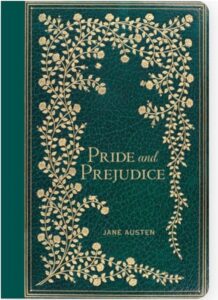 Pride and Prejudice
“It is a universally acknowledged truth that a wealthy bachelor must be seeking a wife.”
The opening sentence of the novel, published in 1813, serves as an excellent lesson in irony. Jane Austen presents a social prejudice as an indisputable truth, while simultaneously exposing an entire world in which marriage is not merely a personal matter but an economic transaction, a strategy for social advancement, and a family obligation.
The word “universally” is the key. The narrator adopts the tone of an authority that brooks no doubt, while in reality she satirizes a society that takes it for granted that a man’s wealth automatically creates the need to find a suitable woman to enjoy it with. The sentence does not merely describe her era; it lays it bare.
Austen was well aware of the limitations faced by women of her social class. Wealth, inheritance, and marriage determined their actual prospects for independence. In *Pride and Prejudice*, the social comedy serves as a vehicle for a rather incisive observation of human behavior.
2. Leo Tolstoy, “Anna Karenina”
“All happy families are alike; each unhappy family is unhappy in its own way.”
Tolstoy chooses to begin his novel with a sentence that resembles a sociological axiom. He does not introduce us to Anna, Vronsky, or Levin. He offers us an observation about families, implying that the story that follows is not just about a specific marriage or a forbidden affair, but the ways in which people try to live within institutions that both protect and constrain them.
This phrase has been discussed countless times, mainly because its generalization seems so convincing that we almost forget it is a literary expression and not a scientific law. Happiness is presented as a state with common characteristics, while unhappiness takes on a personal face. People may seem alike when everything is going well, but the reasons why a life falls apart vary.
*Anna Karenina* was published in serial form from 1875 to 1877 and is considered one of the greatest novels of realism. Tolstoy examines family, marriage, social hypocrisy, love, faith, and the search for meaning, without confining his characters to simplistic moral categories.
3. Franz Kafka, “The Metamorphosis”
“Gregor Samsa wakes up one morning to find that he has been transformed into a monstrous, repulsive insect.”
The opening of “The Metamorphosis,” published in 1915, is one of the most striking examples of how literature can suspend the rules of reality without having to explain them. Kafka does not prepare the reader with a dream, a prophecy, or a supernatural warning. He presents the inconceivable as an event that took place on an ordinary morning.
The exact translation of the German word “Ungeziefer” has puzzled translators, as it does not correspond exactly to any specific zoological term. What matters is the sense of a loathsome creature, a body no longer recognizable as human. The uncertainty of the translation is not some trivial literary problem but part of the text’s power.
What happens next is even stranger. Gregor does not react like the hero of a horror story trying to figure out how the transformation occurred. He worries about his job, his boss, and his inability to show up for work on time. His body is no longer human, but his financial and family obligations continue as if nothing has changed.
4. George Orwell, “1984”
“It was a bright, cold day in April, and the clocks showed thirteen.”
 1984
It is the last word that transforms an ordinary description into a warning. A bright day in April is not threatening in itself, nor is the cold, on its own, a cause for concern. But when the clocks strike thirteen, reality ceases to be entirely reliable. Something isn’t working as it should, and the author doesn’t feel the need to explain to us right away what that is.
George Orwell’s *1984* was published in 1949, in the aftermath of World War II and at a time when propaganda, mass surveillance, and state manipulation had already proven that they did not belong exclusively to the realm of science fiction.
In Winston Smith’s world, the authorities do not merely control the actions of citizens. They seek to control their language, their memory, and ultimately their very perception of reality. The famous phrase “Big Brother is watching you” is perhaps the most recognizable symbol of this world, but the first sentence has already set the stage: a place where even a simple indication of the time can signal that the rules have changed.
5. Gabriel García Márquez, “One Hundred Years of Solitude”
“Colonel Aureliano Buendía, years later, recalls the distant day when his father first showed him ice, while he himself stands before a firing squad.”
The opening sentence of Márquez’s novel, published in 1967, condenses three distinct moments in time with striking economy: an uncertain present, a future that has already become the past, and a memory that returns with the intensity of a revelation.
What is striking is that the narrative does not follow the usual chronological order. It does not begin with the protagonist’s birth nor does it proceed step by step toward the events that will shape his life. It places us simultaneously at different points in the story, as if time were not a straight line but a cycle in which people constantly return to the same memories, the same mistakes, and the same obsessions.
Macondo, the fictional place where much of the story unfolds, is not merely the setting for a family saga. Through the Buendía family, Márquez explores power, memory, violence, the political history of Latin America, and the cyclical nature of human experience.
The book became one of the seminal works of magical realism and played a decisive role in the international recognition of Latin American literature. Márquez was awarded the Nobel Prize in Literature in 1982.
6. Ray Bradbury, “Fahrenheit 451”
“It was a pleasure to burn.”
The opening sentence of “Fahrenheit 451,” published in 1953, has the harshness of a confession. It does not describe a fire as an accident or a disaster. It presents it as a source of pleasure—and from the perspective of a man who has been trained to regard the destruction of books as his duty.
The protagonist, Guy Montag, is a fireman in a society where firemen do not put out fires but burn books. The reversal of a familiar profession is enough to introduce us to a society that has altered the meanings of things, without the need to immediately present its entire political and social system.
Bradbury wrote the novel during a period when the fear of censorship and ideological conformity was particularly intense in the United States. The book, however, is not limited to denouncing the banning of books. It also depicts a society that is gradually losing its patience and its desire to think, as entertainment, speed, and constant stimulation replace meaningful engagement with ideas.
The first sentence is effective because it does not begin with a moral condemnation. It asks us to see the world from the perspective of a man who enjoys his work. The horror does not stem from the fact that Montag is a monster from the start, but from the fact that his society has managed to turn something destructive into something completely normal.
7. Charles Dickens, “A Tale of Two Cities”
“It was the best of times, it was the worst of times.”
Dickens’s opening line, from the novel published in 1859, has become almost independent of the book to which it belongs. Its symmetrical structure, contrasts, and rhythm make it resemble a historical verdict that could apply to more than one era.
The novel is set in London and Paris during the period leading up to and following the French Revolution. Dickens uses these two cities to examine the contradictions of a society that promises progress and justice but can end up in violence, revenge, and the perpetuation of injustice in different guises.
The phrase works through the simplicity of a contrast we all recognize. Eras are never exclusively bright or dark, nor can societies be described with a single label. The same historical period can inspire hope in some and despair in others, creating opportunities and destroying lives.
The phrase continues to be used because every era tends to view itself as unique, whether for better or for worse. Dickens reminds us that history is not as clear-cut as the descriptions we construct in hindsight to make sense of it.
What, after all, makes a first sentence great?
There is something in common that unites all these sentences: none of them is fully revealed upon a first reading. Once we’ve read the entire work, we return to the beginning and discover that the words had more to say than we could have realized at first.
The first line is a promise. Whether the author will fulfill it is determined in the pages that follow. In the case of great works, the miracle is that, when we finish the book, the first sentence no longer feels like a beginning. It feels like something that was bound to be said.
The Elitist

