

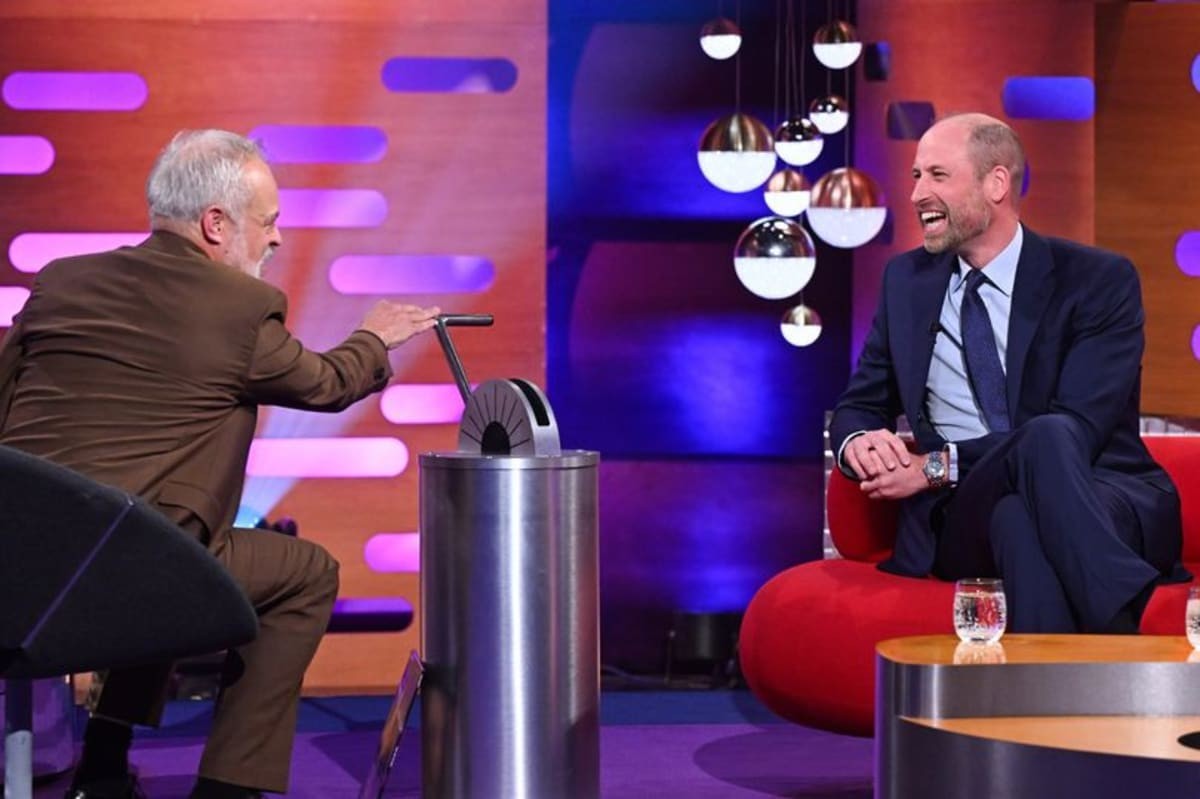

I’m sure we’ve all watched TV interviews where we’d have preferred the host wasn’t there! Sarcasm, a condescending tone, and a pathetic attempt to show that he’s smarter than his guests. I could cite many examples from Greek television, but I don’t want to stray beyond the bounds of Elitist (our religion is bourgeois politeness) nor from my topic, which is the amazing TV host Graham Norton!
His red couch has hosted some of the biggest stars on the planet, from Tom Hanks and Robert De Niro to Adele and countless actors, musicians, and people who have spent years training themselves not to say anything in public that they haven’t already decided they can say. And yet, on Norton’s couch, something strange happens: they let their guard down. (Of course, it’s no coincidence that his guests drink alcohol during the show.)
Norton doesn’t seem particularly interested in their official labels. He doesn’t just see the “star,” the “actor,” the “singer,” or the “comedian.” He’s more interested in the contrast between the persona a person has built in public and who they really are when they let their guard down. And that’s an incredibly useful talent when your job is to talk to people who’ve spent half their lives learning to protect their public image.
Norton knows when to press a person, when to let an awkward silence linger a little longer, when to throw in a quip to break the tension, and, most importantly, when to do absolutely nothing. This last skill is perhaps the rarest. Especially on TV.
Television Without the Host Syndrome
Norton’s greatest skill isn’t talking. It’s listening. The Graham Norton Show is based on an idea that sounds almost too simple: the guests sit together. Not one after another, like back-to-back interviews with the same journalist, but all in the same space, so that one can listen to the other, react, laugh, recall a story of their own, and join the conversation. In this way, the interview gradually ceases to be an interview and becomes a conversation.
That is where much of Norton’s genius lies. He doesn’t try to fabricate the spontaneous moment, as so many talk shows do—shows that are so “spontaneous” that everyone seems to know in advance exactly when to laugh. He simply creates the conditions under which something spontaneous can happen.
An actor who has given the same interview in twenty countries might suddenly hear something from another guest and recall a story he hadn’t even intended to tell. A musician might start teasing an actor. Two people who didn’t know each other before might start chatting with one another.
And then Norton does something that requires far greater self-confidence than just throwing out another one-liner: he lets the moment unfold without trying to make it his own.
There’s a kind of intelligence in television presentation that has little to do with knowledge. It’s the ability to grasp, faster than anyone else, exactly what’s happening in a room. Norton possesses this to an exceptional degree.
He understands when someone is about to say something interesting and doesn’t interrupt them just to get a joke in first. He knows when a story is getting too serious and needs a little dose of irony. He knows when two guests have chemistry and lets them talk to each other instead of mechanically moving on to the next question on his list.
It’s a detail that seems insignificant until you compare Norton to hosts who can’t go five seconds without reminding the audience that they’re there.
Why celebrities feel at ease with him
There’s a very specific reason why Norton has managed to get people who usually guard their public image with extreme care to relax around him. He doesn’t try to expose them in the media.
He doesn’t act as if he’s facing an enemy he needs to trap, nor does he treat every answer as a potential scandal.
The star knows he can make a more personal or bolder remark without Norton rushing to present it as a journalistic trophy. There may be only one question’s difference between indiscretion and a good interview, but the difference lies in the tone and the intent.
Prince William on the red couch
The most resounding confirmation of Norton’s method came on October 23, when Prince William made a surprise appearance on *The Graham Norton Show*, a television setting quite different from the strictly controlled environment of official royal appearances. He became the first member of the British royal family to sit on the host’s famous red couch, alongside Cate Blanchett, Hannah Waddingham, and Robert Irwin. For someone who has learned to carefully weigh every public word and gesture, choosing such company is not merely a matter of public relations. It is also a tangible acknowledgment of Norton’s ability to create an environment where even the most institutionally protected guests can appear more human and less formal.

William spoke about his love for Christopher Nolan’s films, revealed that he watches *Celebrity Traitors* with his children, and recalled that when he was younger, he had thought about becoming a police officer or a DJ.
This is precisely the area in which Graham Norton excels. He doesn’t need to turn an interview with a prince into an interrogation or pretend that the mere presence of a member of the royal family is, in and of itself, a journalistic revolution. All he needs to do is create an environment where a person with extremely strict limits on public exposure can speak with a little more ease. And when he achieves this with a future king, the value of his approach becomes even more apparent.
The most interesting thing about Graham Norton is that his success is based on qualities that today’s culture of public exposure treats almost as weaknesses.
He isn’t constantly angry. I’d say he’s perpetually cheerful. He doesn’t try to shock with every line. He doesn’t treat every opinion as a historic revelation, and he doesn’t seem to think that every appearance has to serve as an advertisement for his personal brand.
True social confidence doesn’t require constant validation. The more certain someone is of their position, the less they need to flaunt it. Norton has managed to transform this self-restraint into a television style, and perhaps therein lies one of the most elegant lessons an entertainer can teach in the age of personal branding.
The luxury of his show, after all, doesn’t lie in the sets or the production costs. It lies in the mix: big names, diverse personalities, the right pace, humor, and the feeling that someone managed to organize an exceptionally good dinner party and simply set up a camera and a bottle of wine across from them.
The Elitist

