


Two decades ago, rosé had a specific place in the international wine market: it was a pleasant, affordable wine, associated mainly with summer, beaches, swimming pools, and carefree meals by the sea. Today, its image has changed radically.
Much of this transformation is due to one man: Sacha Lichine, the creator of Whispering Angel.
His story is particularly interesting because it’s not just about a successful wine but about how an entire product category can carve out a different niche in the market, once one realizes that true value lies not only in the contents of the bottle, but also in the story that accompanies it.
The man who saw something others overlooked
Sacha Lichine was not just any entrepreneur who suddenly discovered the world of wine. He was born into a family with deep roots in French winemaking. His father, Alexis Lichine, was one of the most important figures in the international wine trade of the 20th century, originally from Russia and having spent his life between France, the United States, and the great vineyards of Bordeaux.
Alexis Lichine had acquired Château Prieuré-Lichine in Margaux and had contributed significantly to the promotion of French wine in the American market. His son grew up in this environment, learning not only about winemaking but also the importance of distribution, communication, and brand identity.
In 2006, Sacha purchased Château d’Esclans, an estate near La Motte in Provence, northeast of Saint-Tropez. The choice was not an obvious one. At that time, France’s great wines were still primarily associated with Bordeaux, Burgundy, and Champagne. Rosé was rarely even part of the same… conversation.
The significance of an almost transparent hue
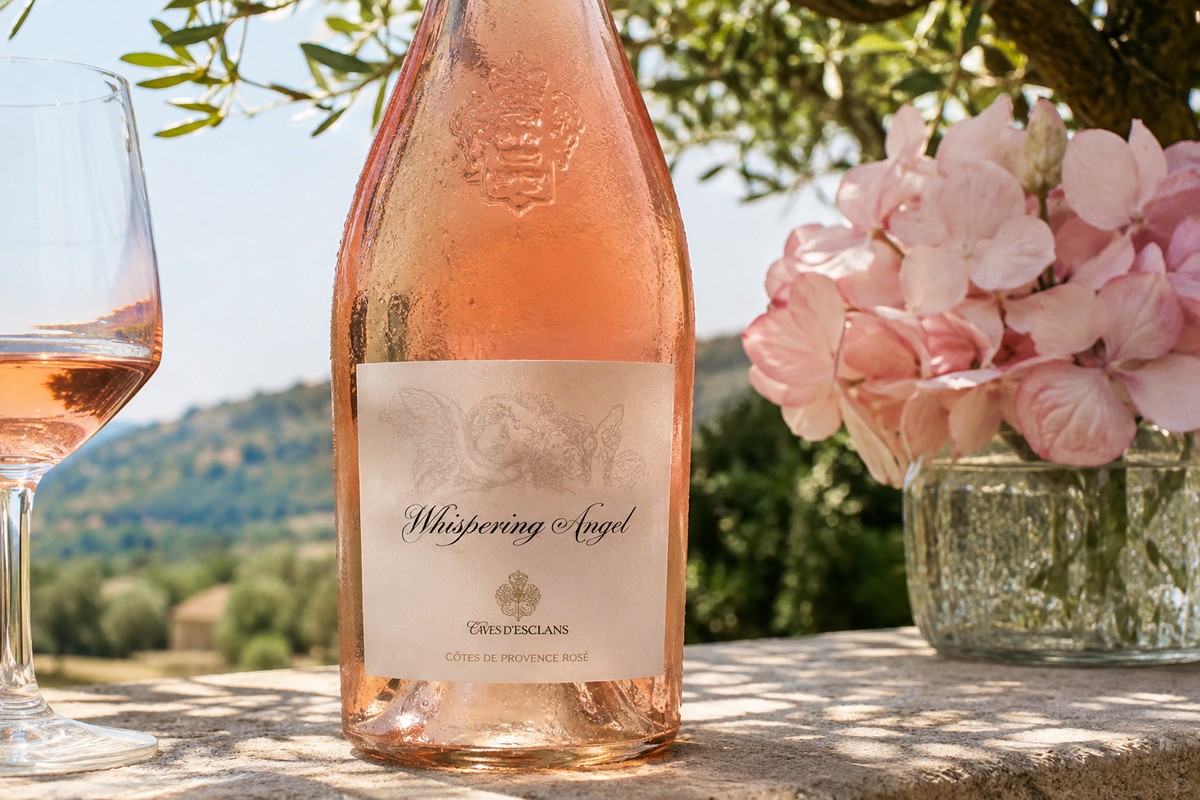
Whispering Angel was created with a specific aesthetic and winemaking philosophy. A soft peach color, a dry character, pure fruit, an elegant bottle, and an image that evoked a sophisticated lifestyle rather than a conventional everyday wine.
The color proved to be decisive. The very light pink became a recognizable feature of modern Provence. The wine’s visual appeal was exceptionally photogenic, a trait that took on even greater significance with the rise of Instagram and digital travel culture. Its photogenic appeal and flavor managed to charm even my wife, who, until she discovered it, almost never drank wine (she always preferred bourbon)!
The name was just as important. Whispering Angel. No mention of grape varieties, vineyards, or technical terms. A name that’s easy to remember, universally understood, and poetic enough to resonate regardless of the consumer’s language. The packaging, color, and name created an identity that was recognizable even before anyone tasted the wine.
The Bordeaux Behind the Provence Rosé
The success was not based solely on marketing. Lichine collaborated with Patrick Léon, an experienced oenologist who had worked for years at Château Mouton Rothschild.
The goal was to apply to rosé production some of the techniques and precision that characterized the great wines of Bordeaux. Careful grape selection, temperature control, oxidation management, and a tailored approach to each cuvée became key elements of the production process.
The Grenache, Cinsault, and Rolle grape varieties are key components of Whispering Angel. Fermentation and aging of this wine take place primarily in stainless steel tanks to preserve its freshness and aromatic characteristics.
This distinction is important because the Château d’Esclans wine family encompasses very different winemaking approaches. At Les Clans and Garrus, fermentation takes place in oak barrels, with the aim of achieving greater structure and complexity. Lichine didn’t simply want to sell more rosé. He wanted to prove that the category could also achieve the complexity of a serious, age-worthy wine.
Whispering Angel became the face of this endeavor. The estate’s more expensive wines served to bolster its winemaking credibility.
From Saint-Tropez to the Hamptons
Lichine’s true business success lay in his ability to transform a Provençal wine into an international symbol of high society. Whispering Angel began appearing in restaurants, hotels, beach clubs, and entertainment venues catering to a well-heeled, well-traveled clientele. The geography of his success was no accident: Saint-Tropez, London, the Hamptons, Palm Beach, Saint Barths, and Alpine resorts.
The selection of these markets was more significant than a simple advertising campaign. The wine became associated with specific experiences and locations. It didn’t have to be the most expensive item on the menu. It was enough for it to appear in the right setting, alongside people who shaped the consumption habits of a broader audience.
The Acquisition That Confirmed Its Success
In 2019, the LVMH Group, through Moët Hennessy, acquired 55% of Château d’Esclans. Lichine retained the remaining 45% at the time and continued to participate in the company’s growth.
The agreement held particular symbolic significance. One of the world’s most powerful luxury conglomerates recognized that this Provençal rosé could be a strategic investment alongside historic houses and major wineries.
In March 2026, Lichine stepped down from management after two decades at the helm of the company. Bruno Yvon, an executive with extensive experience at Moët Hennessy, took over as CEO. His departure coincided with the 20th anniversary of Whispering Angel. The wine, which began in 2006 as an ambitious venture, had evolved into an international brand with a presence in more than 100 countries.
Is it really worth the money?
The question is inevitable. Is Whispering Angel a good rosé or an exceptionally successful marketing product?
The answer doesn’t have to be definitive. It is a well-crafted, dry, refined rosé with a consistent character and a recognizable style. However, it is not the only good rosé from Provence, nor is it a wine that will necessarily offer greater enjoyment than any of its competitors in the same price category.
On the Greek market, a bottle of Whispering Angel typically ranges from about 22 to 30 euros, depending on the supplier and the vintage. In a restaurant, the price may be significantly higher. For a wine in this category, part of the price reflects its quality and part its brand value.
A lesser-known rosé from Provence can offer an equally interesting experience at a lower cost. Whispering Angel offers something extra: the feeling of being part of a specific aesthetic and social culture.
Whether this feeling is worth the price difference is a personal choice.
The Elitist

