

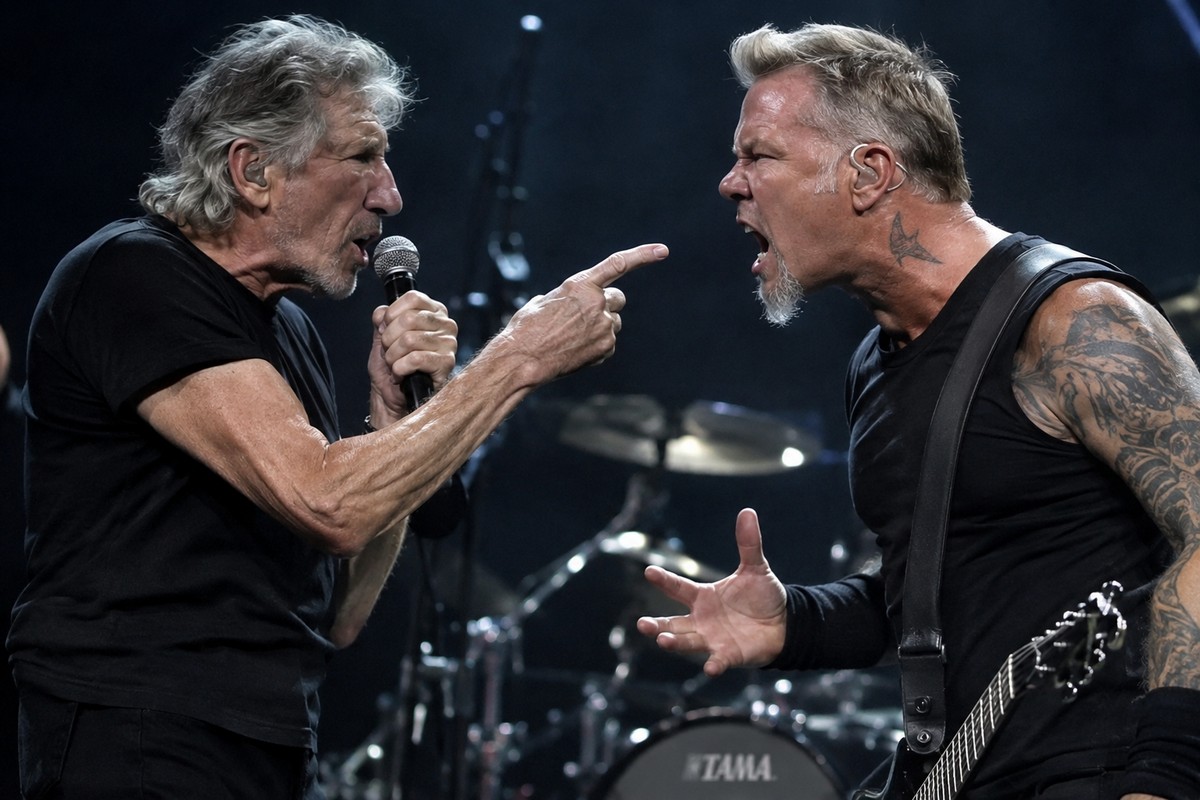

Rock music was born to provoke, challenge, and break rules. Somewhere along the way, however, some musicians began to treat the microphone as a political platform and their audience as listeners who are obligated to hear not only their songs but also their views on the world.
Others, however, believe that a concert is not a political rally, and that the audience has not paid for a ticket to attend a lecture on ethics.
A notable disagreement on this issue occurred between Roger Waters and James Hetfield, with many personal insults—both direct and indirect—exchanged on both sides.
On October 10, 2026, during Metallica’s concert at the Sphere in Las Vegas, James Hetfield thanked the audience who had traveled to see the band, explaining that Metallica isn’t there to influence the audience with their political views. Their agenda, he said, is love, energy, and loud music. He didn’t name any of his colleagues, but the message was clear enough to spark reactions at a time when artists’ political stances have become almost a mandatory test of public consciousness.
Roger Waters “jumped on the bandwagon” and didn’t let the opportunity pass him by. During an appearance on Katie Halper’s podcast, he called Hetfield a “complete prick,” questioned his intelligence, and called him “nobody,” adding that he even doubts his musical abilities. The attack was personal and wasn’t limited to a political disagreement. Waters questioned the artist himself, as if the decades-long legacy of one of the world’s greatest heavy metal bands could be nullified simply because its lead singer refuses to turn his concerts into public political statements.
Waters is a usual suspect. He has spent decades denouncing war, authority, nationalism, and whatever he considers political hypocrisy. In the world of Pink Floyd, politics was not a mere decorative detail. “The Wall” and “Animals” addressed alienation, authoritarianism, social hierarchy, and manipulation in ways that went far beyond the narrow confines of pop entertainment. It would be rather absurd to ask an artist who has built a significant part of his body of work on political criticism to suddenly abandon that dimension.
Hetfield represents a different perspective. Metallica has written songs about war, power, injustice, addiction, and human destruction, without needing to turn every concert into a declaration of a specific political stance. “One,” “Disposable Heroes,” and “…And Justice for All” aren’t exactly music without social commentary. The difference lies in how the message is conveyed. It’s one thing to let a song raise questions; it’s quite another to ask the audience to sit through a speech between two songs.
The problem with Waters isn’t that he defends the political dimension of music. It’s that instead of explaining why he considers Hetfield’s stance problematic, he resorts to personal characterizations and disparaging judgments. Invoking political sensitivity does not automatically turn an insult into an argument. If one defends kindness, empathy, and human dignity, it would be helpful to remember that these values are put to the test especially when addressing people with whom one disagrees.
One might prefer the sound of Pink Floyd, consider Waters the more important lyricist, or find heavy metal excessively loud. Aesthetic preference, however, is not an objective measure of musical value. Metallica has shaped the sound and trajectory of heavy metal for more than four decades, and their influence does not depend on whether Roger Waters likes them.
No one needs to choose sides. The audience has every right to listen to Waters denounce authority and then go to a Metallica concert the next day without asking Hetfield to explain the geopolitical situation to them. Art can be political without necessarily being didactic, just as it can offer an escape without becoming a denial of reality.

