

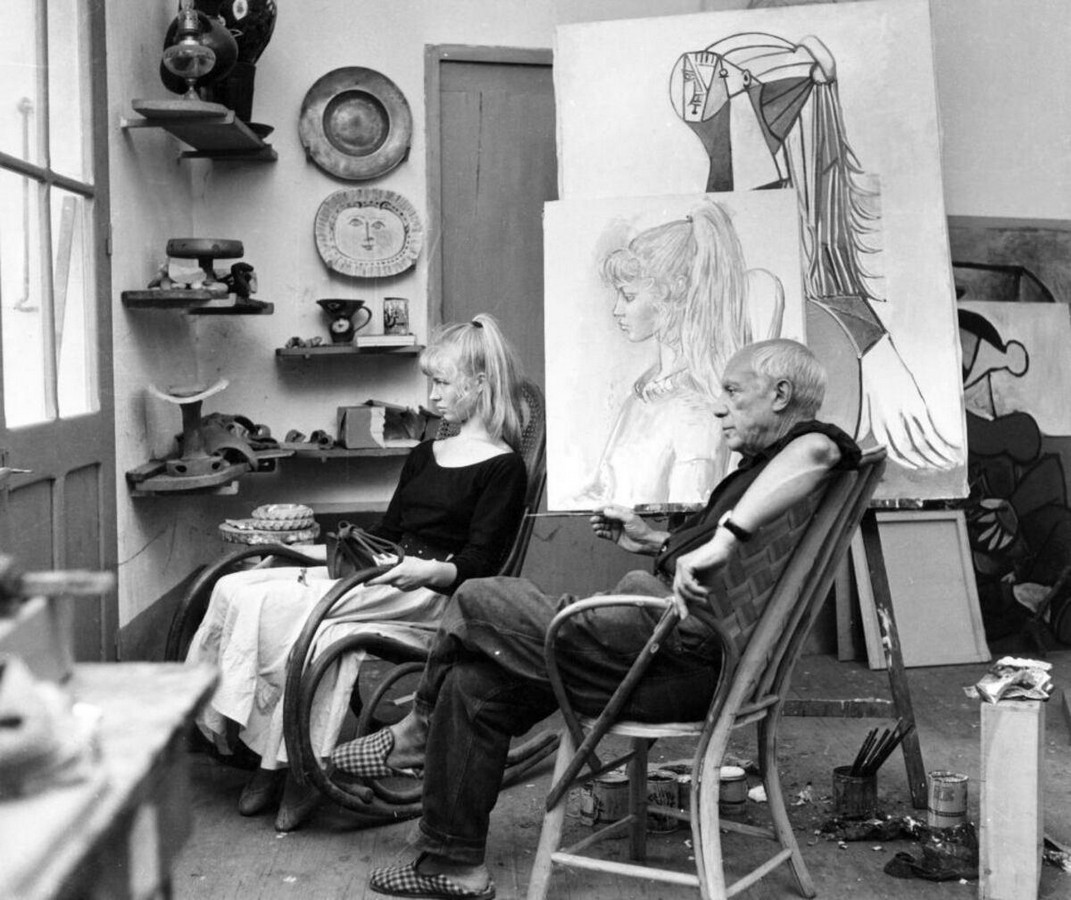

In the spring of 1954, something unusual happened—even by Pablo Picasso’s standards. The man who had spent his entire life searching for new forms of expression, who had deconstructed the human face and changed the history of painting, found a face he couldn’t tear himself away from. He wanted to paint it over and over again.
Her name was Sylvette David. She was just 19 years old.
They met in Vallauris in southern France, where Picasso was living and working at the time. Sylvette was in the area with her partner, the English furniture designer Toby Jellinek. He had crafted some chairs that caught the painter’s eye. The couple took them to his studio, and thus began an encounter that would go down in art history.
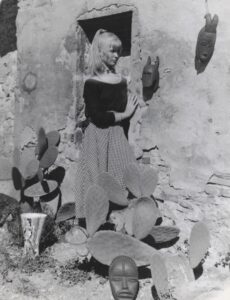
Picasso immediately noticed the young woman. Her blonde hair, tied back in a high ponytail, her long neck, her delicate profile, and her somewhat stern expression had something that captivated him. She bore a striking resemblance to Brigitte Bardot. Brigitte Bardot adopted the same hairstyle, most likely after seeing the extensive coverage of Sylvette David in *Paris Match* magazine and other publications. Bardot had once come to meet Picasso. As she later wrote in her autobiography, she had asked Picasso to paint her. He refused, telling her that he had already painted Silvet David and that the two of them looked exactly alike!
In about three months, from late April through June 1954, he created approximately sixty works inspired by her: paintings, drawings, ceramics, and sculptures. Picasso used her face to experiment with different versions of the same image, ranging from nearly photographic depictions to intensely Cubist compositions.
Sylvette became known as “the girl with the ponytail.” The series of works earned its own place in art history and was exhibited in Paris, generating great interest.
The most interesting aspect of the story is that their relationship was not romantic. Sylvette did not become just another of Picasso’s mistresses. Her partner was present during their sessions, and she herself has described the painter as a man who encouraged her to discover her own creativity.
Picasso allowed her to choose a painting in exchange for the hours she spent posing. She chose a black-and-white portrait because, as she later explained, it most closely resembled her true likeness. Years later, she was forced to sell it when Toby Jellinek was hospitalized with tuberculosis and they needed money for his treatment.
Her story did not end in Picasso’s studio. Sylvette, who later adopted the name Lydia Corbett, took up painting herself, although she didn’t begin creating works consistently until several years later. Her artistic career developed far from the shadow of the famous painter. Sylvette is still alive, and you can see her and her artwork on her Instagram account, Lydia Corbett Sylvette David!
Most people remember Picasso’s women through their tumultuous romantic relationships. Sylvette is a different story. She didn’t have to become his mistress to become his muse. Sylvette David went down in history not because she was just another woman in Picasso’s life, but because, for a brief period, she became the subject of an unusual artistic obsession. Sixty works in just a few months is a number that can hardly be explained as mere inspiration. For Picasso, Sylvette was not merely a model but a person he wanted to explore through painting—to distort, to reconstruct, and ultimately to capture in dozens of different ways. The result was one of the most recognizable series of portraits from the postwar period.

