


Today, luxury has lost its refinement. The major fashion houses have sold out to bad taste and design clothes, accessories, and cars for people who have plenty of money but no class. A few decades ago, however, things were different. The Maserati 5000 GT is one of the best examples of this old-school form of luxury. Its story begins in the late 1950s, when the Shah of Persia, Mohammad Reza Pahlavi, visited Maserati and test-drove the 450S race car.
He was impressed by the V8 race engine but wanted something the 450S could not offer: a road car that retained Maserati’s racing DNA while offering the comfort, quality, and presence of a grand tourer.
Maserati did what today would be considered almost absurd from a production standpoint. Instead of telling him which model he could buy, the company decided to create a brand-new car that would satisfy customers like him. Thus, the 5000 GT was born.
From the Shah to Pietro Frua
Under the hood was a roughly five-liter V8, an evolution of the engine found in the 450S race car. The 5000 GT was essentially a transfer of Maserati’s racing know-how to the road, but without the sheer brutality that characterized race cars.
Maserati did not treat the 5000 GT as just another model to be produced in the thousands. It collaborated with some of Italy’s most prominent carrozzerie, giving designers and body builders room for their own personal interpretations.
The result was the production of just 34 cars.
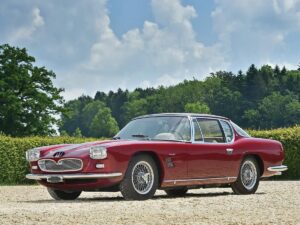
Today, the term “limited edition” is used so frequently that it has almost lost its meaning. It can mean 500, 1,000, or even 5,000 units, as long as the marketing department has decided they should be considered rare. In the case of the 5000 GT, its rarity wasn’t a marketing ploy. It was a consequence of the way the car was built.
Among the various versions, Pietro Frua’s stands out. Frua was one of the great Italian designers of the postwar period and had a different approach to how a car should be designed. He didn’t try to impress by adding unnecessary elements. Instead, he strove to make the proportions work so well that almost nothing else was needed. Of the 34 5000 GTs produced, only three were fitted with a body designed by Frua.
A King’s Red Car
This particular car, with chassis number 103,064, was unveiled in Geneva in 1963.
In 1966, it was returned to Maserati when its then-owner decided to purchase a new model from the company. That’s when one of those small details that make the history of these cars so fascinating came into play. The car was restored and repainted, this time in Rosso Rubino Chiaro, a deep red that complements Frua’s curves almost too perfectly.
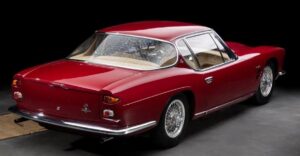
The next owner was Saudi Prince Majid bin Saud, who bought it and presented it to his father, King Saud bin Abdulaziz Al Saud.
Thirty Years in the Dark
In 1967, following the Six-Day War and King Saud’s departure from Egypt, Egyptian authorities confiscated the car. The 5000 GT Frua was transported to a storage facility in Cairo, where it remained for more than three decades.
A car built for kings, designed by Frua, and powered by a race-bred engine had been locked away in a warehouse for decades.
When the 5000 GT Frua reappeared in 2000, it had traveled just 12,700 kilometers. A collector from Texas acquired it and returned it to Modena, where it underwent a four-year restoration. In 2004, it reappeared at the Concorso d’Eleganza Villa d’Este. The Maserati, once built for a king, had returned to where it belonged: at the forefront of European automotive aesthetics.

