

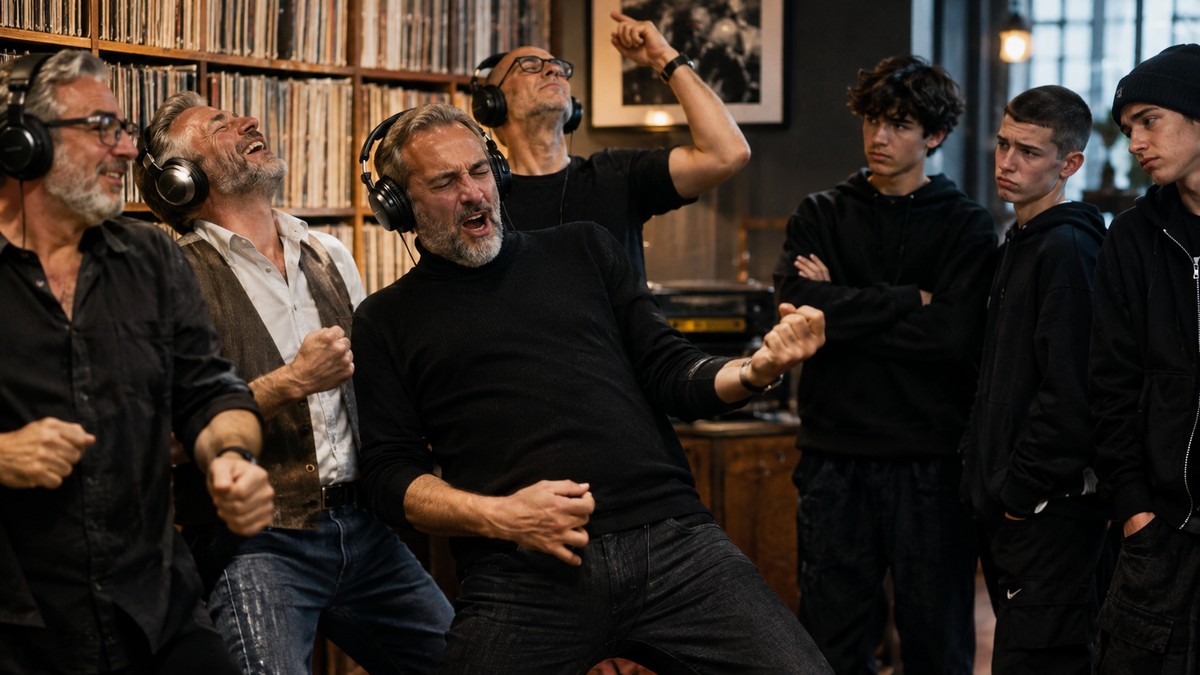

Old people are strange: They liked songs with a melody!
A quip from some 15-year-olds dressed in black might just be the most spot-on musical comment of the year. Older people are strange. They liked the melody. They looked for songs with a beginning, middle, and end; they were enthralled by the guitarist’s solo; and they recognized a musical phrase from the very first five notes.
Today, in the age of AI music and awful trap, melody seems almost like an outdated habit. Music has taken on other characteristics. The beat has to kick in fast, the bass has to hit hard, the vocals must be run through enough filters so it’s not entirely clear who’s singing, and the lyrics must contain the requisite references to money, expensive cars, guns, designer clothes, and women. If there’s room to spare, a melody can be added as well.
Trap is the most characteristic example of this aesthetic. I’m not going to argue that the entire genre is musically uninteresting. It has created its own language, expressed social realities, and brought to the fore artists with distinct personalities. The problem lies in its commercial formula and the incredible ease with which repetition is presented as creativity. When a song can be replaced by fifty others without anyone noticing the difference, perhaps it’s not just the audience’s auditory memory that’s to blame.
I can’t resist making the comparison: Listen to “Sultans of Swing” by Dire Straits. Notice how Mark Knopfler’s guitar evolves, how the tension builds, and how every instrument has a purpose. Listen to Pink Floyd’s “Comfortably Numb” and wait for David Gilmour’s solo. You don’t need to know music theory to understand that something more than just the repetition of a rhythm is happening there.
These aren’t just old songs that older generations love. They’re mini-lessons in composition, orchestration, dynamics, and musical storytelling. They’re proof that a song can surprise you, transport you somewhere, and continue to reveal new details even after you’ve listened to it a hundred times.
And so, while today’s commercial music has lost its melody, musicians’ next competitor is emerging: artificial intelligence.
Music production is turning into a process that’s more like ordering a cup of coffee. One song, please—a little blues, plenty of melancholy, a male voice, something between Leonard Cohen and contemporary country. Black, no sugar, so to speak…
The data shows that this isn’t just a theoretical threat. According to Deezer, in July 2026, AI-generated compositions exceeded 50% of new daily uploads on the platform for the first time, reaching an average of about 90,000 tracks per day in June. The paradox is that this enormous volume of music accounts for only 1% to 3% of the service’s total streams. In other words, we’re producing music in industrial quantities without a corresponding desire to listen to it.
What’s even more interesting is that Deezer has found that as much as 85% of streams of fully AI-generated tracks in 2025 were linked to fraudulent playback practices. In other words, some people are trying to flood platforms with artificial songs and artificial plays to collect royalties.
Of course, let’s not be hypocritical. Artificial intelligence isn’t the sole culprit behind the decline in creativity. Long before that, the music industry had begun treating songs as products with a specific shelf life, designed for playlists, algorithmic recommendations, and rapid consumption. AI now simply offers the ability to produce these products without even needing to involve a real musician.
So perhaps the curious older folks from the opening line are right. They may not understand the aesthetics of trap music, may not care about the latest music trends, and may still believe that a good solo is worth more than a repetitive bassline. They may insist on listening to entire albums, buying records, and patiently waiting for their favorite part of a song. If that makes them seem strange, so be it. At least they know the difference between a song and a sound that merely exists.
And if artificial intelligence ever manages to write the next “Sultans of Swing,” we’ll tip our hats to it. Until then, let’s keep our guitars and let the robots make the playlists.
Patroklos Koudounis

